


WHEN THE FOREST IS THE STRUCTURE: USING MATURE BIOMASS AS REAL ESTATE INFRASTRUCTURE
The urban grid extracted immediate yield while manufacturing a permanent thermal trap. Concrete bleeds heat straight through the night. Infrastructures, towers, then landscape shows up near the end to fill the remaining ground.
A few developers across Asia worked it the other way. They fixed the forest first, sometimes before the land was even assembled, then made the buildings. The results are worth studying: richer in species, and measurably cooler to stand in.
“Most people writing the cheque here are in their fifties, with parents to settle and kids still under the roof. The green earns its keep twice over: somewhere the parents can walk and sit through the day, somewhere the kids can be let loose and pick up a bit of learning. It clears two bills he had already resigned himself to paying, off one piece of ground,” said Leong Boon Hoe, founder and CEO of Arcadia Consulting Vietnam.
Each section below pairs the project with the conditions around it that made the decision legible to a city, a regulator or a community.
THE FORESTIAS, BANGKOK: THE MIYAWAKI METHOD AND DISTRICT COOLING INFRASTRUCTURE
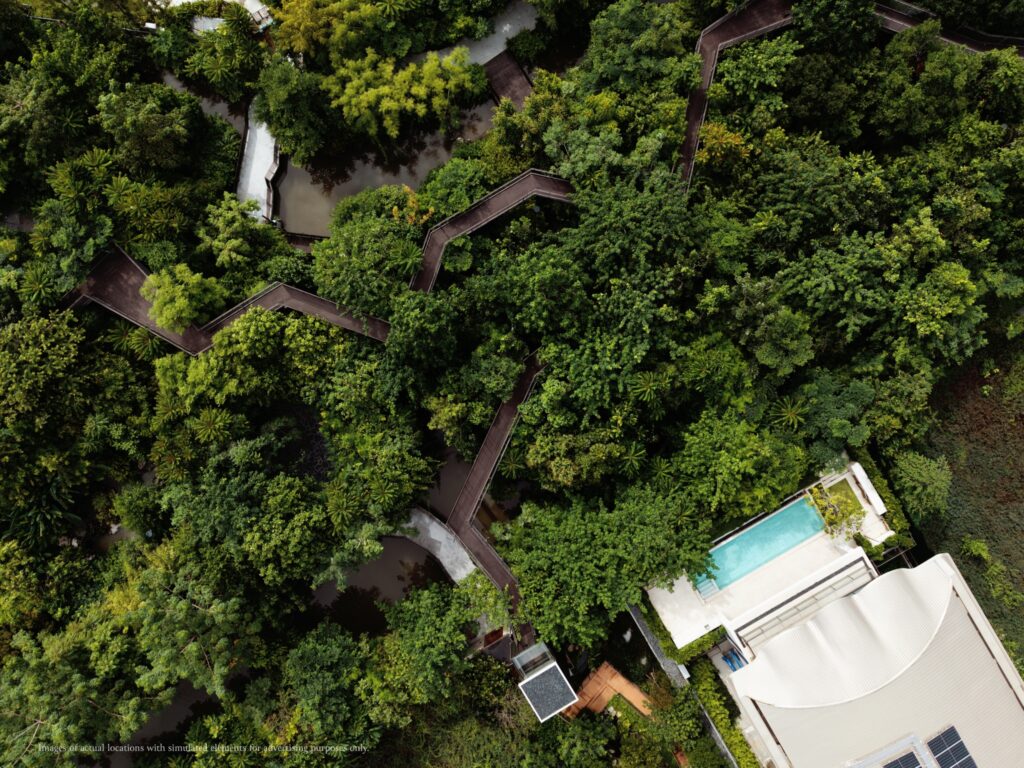
MQDC’s The Forestias sits in Bangna, on Bangkok’s emerging eastern flank. Ground broke in October 2017 across roughly 398 rai, about 64 hectares. Foster + Partners set the masterplan, Grant Associates and TK Studio the landscape, and Atelier Ten wrote the sustainability framework in 2017, ahead of the vertical work.
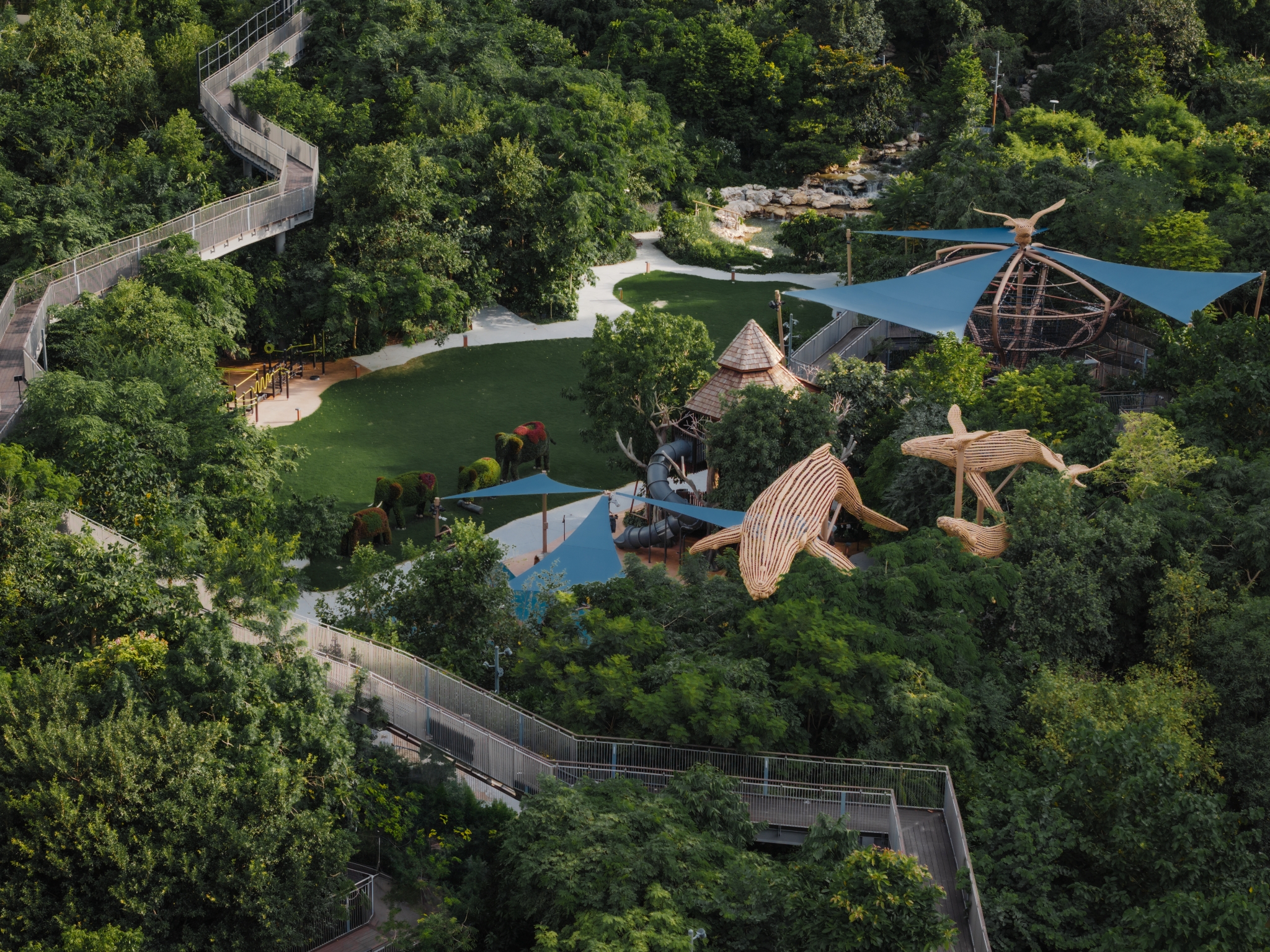
Two forests were built for different purposes.
- The Deep Forest, about 30 rai, is fenced and closed to residents. Only wildlife and rangers enter. Planting follows Akira Miyawaki’s method, dense and multi-layered, weighted to locally indigenous species, with the soil worked hard before anything goes in.
- The Resident Forest is walkable, linked by a skywalk and a 1,600-meter path with seating every 400 meters for senior residents.
The densest, most biologically active ground stays off-limits to people by design, so the wildlife has somewhere undisturbed to settle. The biodiversity record runs from before the bulldozers:
- 53 plant species on the site before 2020; 557 documented by 2024.
- 271,901 seedlings introduced from 533 species across about 77,360 square meters, with a native backbone of 183 indigenous species among 23,258 saplings.
- Recorded animal species up from 83 before 2020 to 104 in 2023 and 176 in 2024, with residents and migratory birds doing most of the climbing.
The development planted 533 species and later counted 557. The extra two dozen showed up on their own, the same self-recruitment Otemachi recorded, further along its curve.
By the developer’s account, The Forestias was the first residential and commercial development in Thailand to run a Central Utilities Plant, a single facility that chills water and pipes it underground so towers buy cooling instead of running their own chillers.
- Installed cooling capacity of about 20,000 refrigeration tons through the district plant, against roughly 32,323 for a conventional fit-out.
- Refrigerant emissions near 28,600 tons of carbon-dioxide-equivalent, against roughly 66,749 for a conventional setup.
- Rooftop solar of 15 MW planned against about 50 MW of expected demand, near 30% of supply.
Water closes the loop that keeps the forest alive. A dense, largely transplanted ecosystem in Bang Na needs consistent volumes through the dry months. The Forestias treats all its wastewater and routes it to irrigate the forest and its ponds, with rainwater harvesting on top. Then buildings make the water the forest drinks; the forest drops local temperature by a measured 3 to 5 degrees Celsius.
OTEMACHI FOREST, TOKYO: TRANSPLANTING INTACT SOIL MICROBIOMES FOR FLOOR-AREA INCENTIVES
Tokyo Tatemono grew part of its forest somewhere else first, then moved it into the financial district.
Otemachi sits beside the Imperial Palace. After a slice of primary forest was recreated inside the palace grounds, the later authorization to densify the adjacent business district expected small urban forests of high ecological quality to be planted through the district in the palace’s spirit. The Otemachi Forest, about 3,600 square meters at the foot of the tower and designed with the landscape office Michel Desvigne Paysagiste, grew out of that lineage.
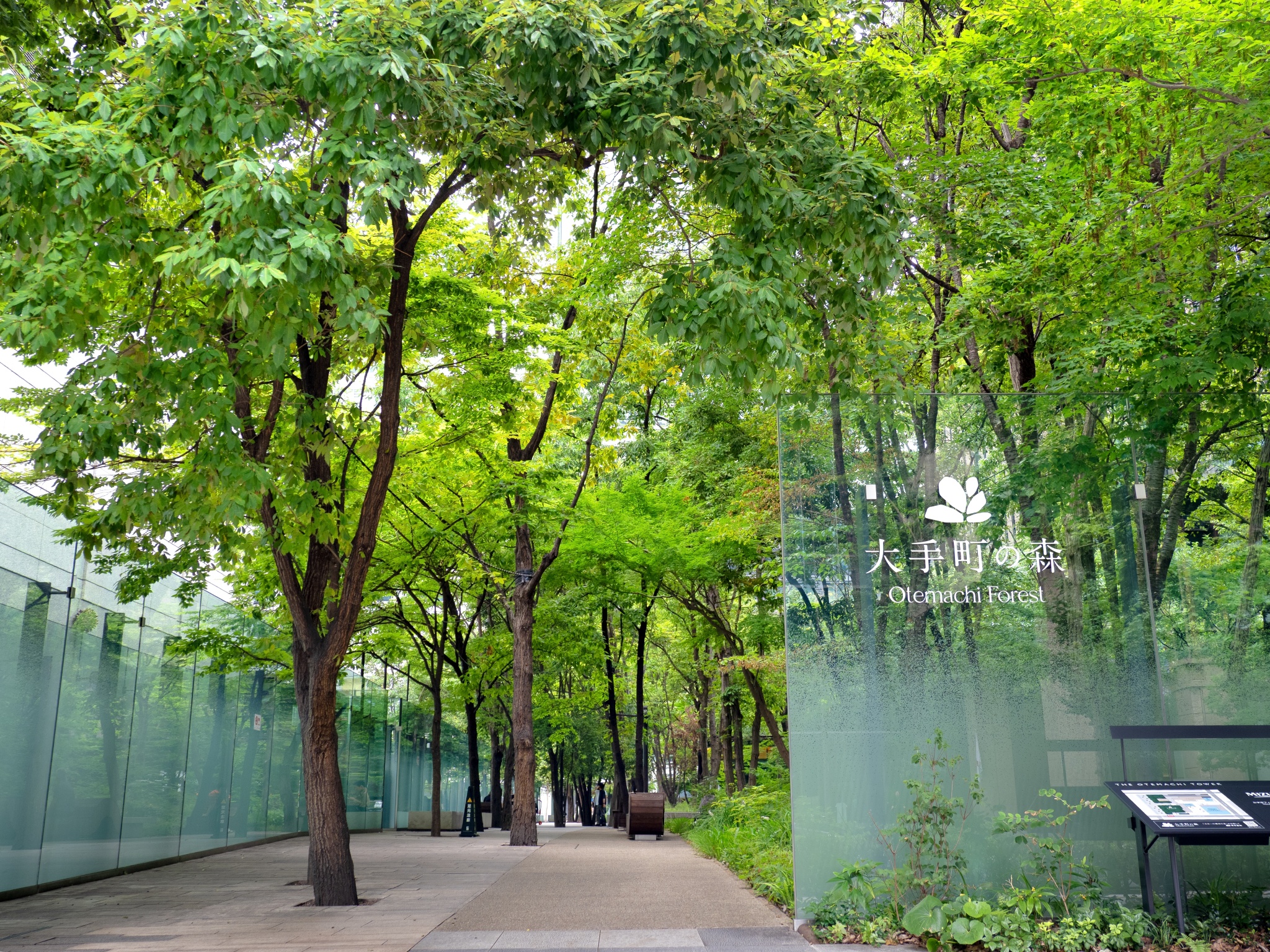
- About a third of the forest, roughly 1,300 square meters, was built in advance in the mountains of Kimitsu, Chiba, on a proxy that copied the Otemachi slopes and even the incline of the concrete slabs the trees would sit on.
- Over 200 tall trees were arranged there, weighing around 70% deciduous to match the local climate.
- It grew for three years. Roots settled, soil biology stabilized, insects moved in on their own.
- At installation the forest came in with its soil, transported to a depth of around two meters, so the living seed bank and fungal community travelled with it.
Tokyo Tatemono’s own reporting records roughly 300 plant species about eighteen months after installation, against an original planting near 100. The extra 200 were never planted by anyone.
- They germinated from the dormant seed bank in the transplanted soil, and several appear on Japanese national and Tokyo Metropolitan Red Lists. Dragonflies arrived from the Imperial Palace grounds.
- The forest sits on an engineered slab above a metro station and still knits into the palace’s green network, which is the whole intent of the imperial condition.
Large Tokyo projects earn extra floor area when they hand the city public open space and ecological greening, through the comprehensive design and urban redevelopment provisions. Otemachi gave ground and underground daylight to a forest and recovered value in the floors above it.
Keeping existing green space beats replanting, because it keeps the microorganisms and invisible seed bank.
MARINA ONE, SINGAPORE: PASSIVE URBAN COOLING AND MANDATORY LUSH COMPLIANCE
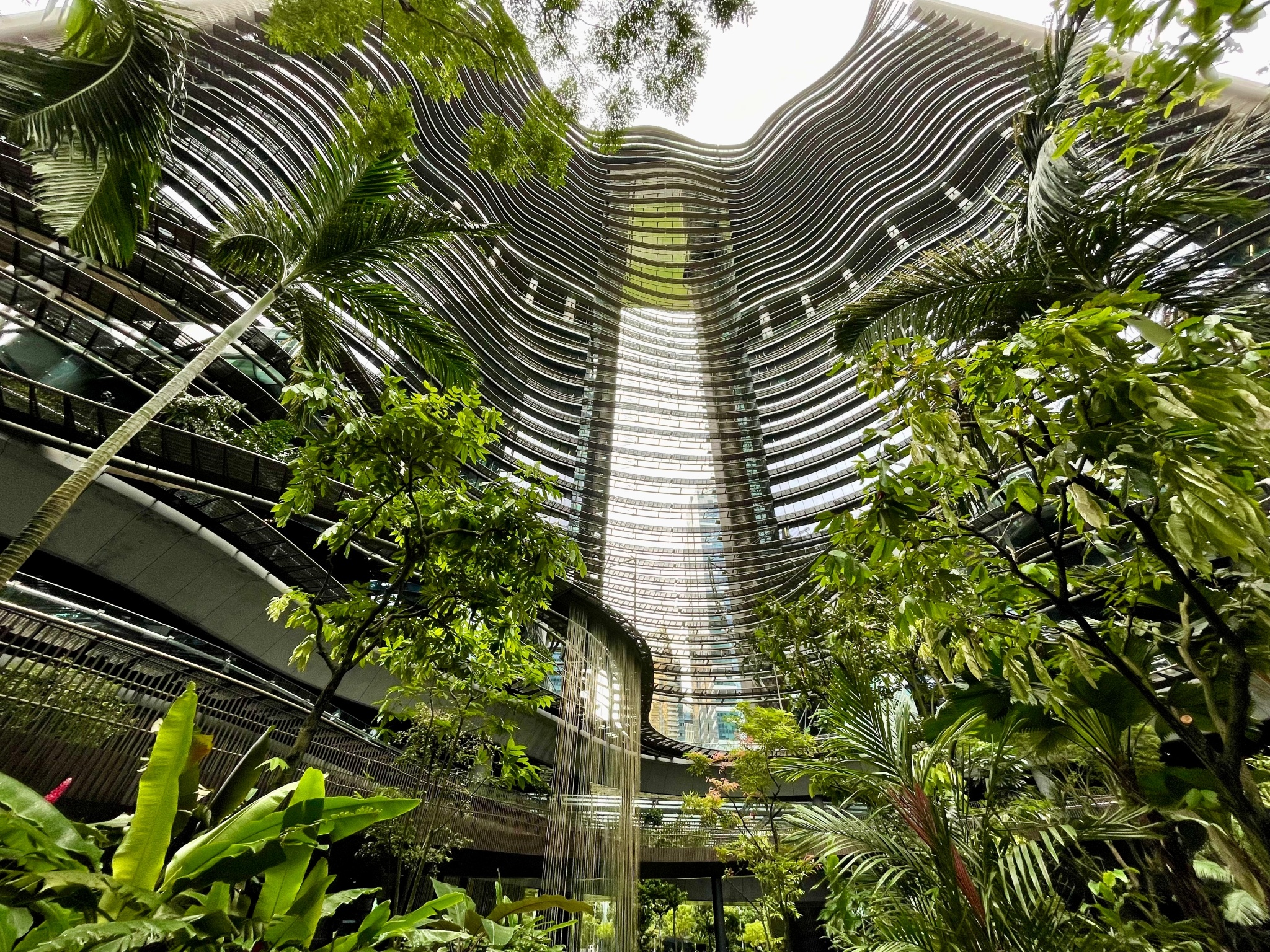
The Green Heart at Marina One runs to about 37,000 square meters, the largest public landscaped space in the Marina Bay business district.
- Its size came from a geometry fixed before the towers’ forms were: four buildings positioned to create the garden, then curved and stepped to draw prevailing winds down into the courtyard and ventilate the whole valley.
- Christoph Ingenhoven designed the complex; Gustafson Porter + Bowman shaped the planting, with ICN Design and Architects 61 working locally.
- The designers took their reference from Asian rice-paddy terraces, planted across roughly 700 trees and 350 species.
The Urban Redevelopment Authority has run its City in a Garden policy for years, and the LUSH scheme requires tall buildings to put back the greenery their footprint removes.
- In that setting, a landscaped area larger than the plot it sits on is closer to what the rules expect than to any one-off generosity.
- The Green Mark Platinum and LEED Platinum ratings rest partly on cooling the planting delivers without machinery, and the three-story waterfall is there for the humidity, and the temperature drop it carries across the courtyard.
Marina One sits inside a dense financial district ringed by towers, so the wildlife connectivity that lets Otemachi recruit species does not exist here in the same form. The garden is a self-contained valley.
SINDHORN VILLAGE, BANGKOK: ANCHORING COMMERCIAL RETAIL AROUND HERITAGE ROOT SYSTEMS
Sindhorn Village on Langsuan Road took the inverse route to The Forestias. The forest was inherited, and the development bent around it.
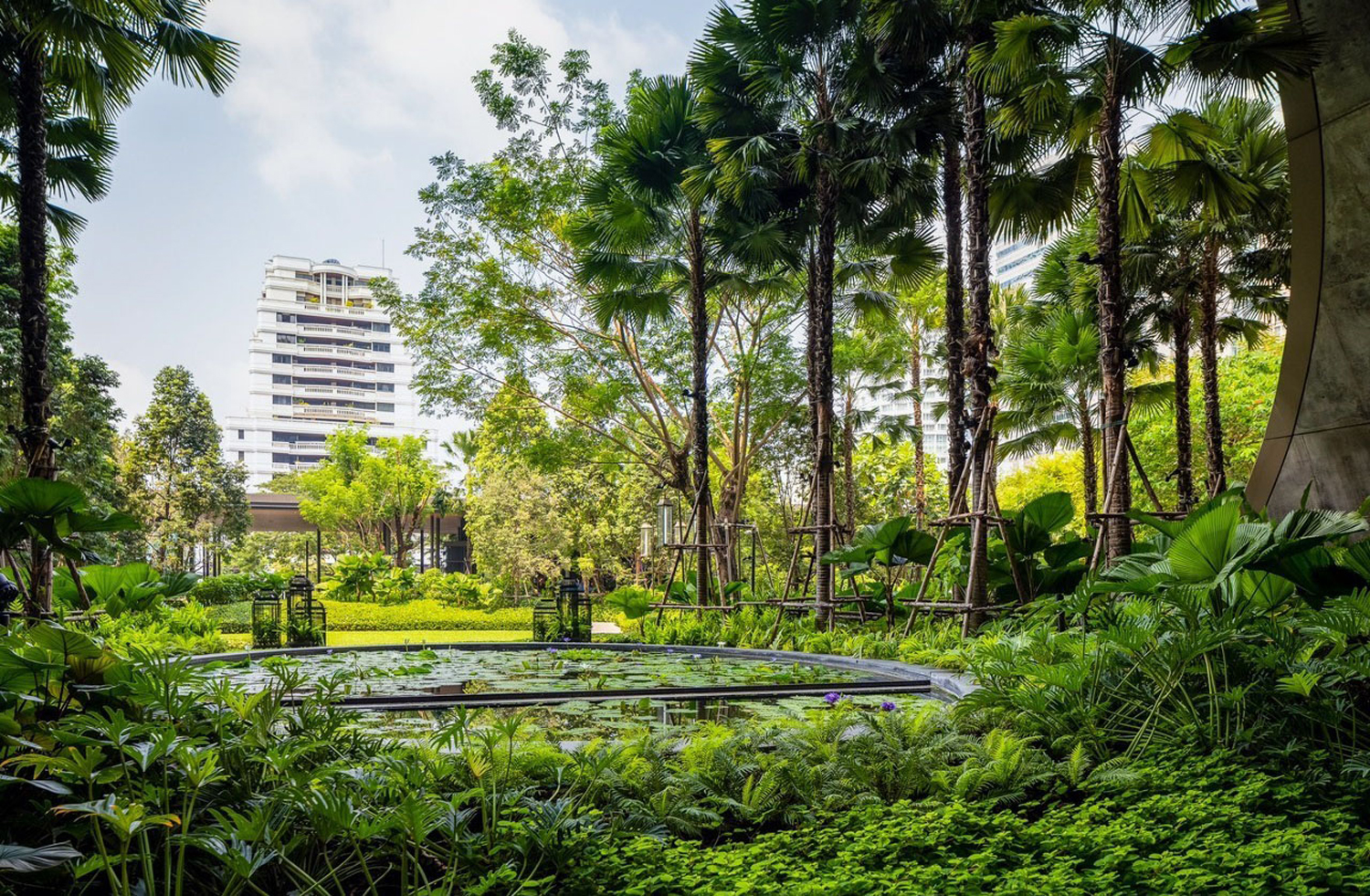
Langsuan was Bangkok’s embassy quarter for generations, and its character came from century-old rain trees, flame trees, champakas and pines grown undisturbed across the 8-hectare site. Those trees carried value built over decades, in root depth and soil life as much as in canopy.
Working with Architects 49, the developer committed to keeping every significant mature tree before design began.
- The retail then meanders about 300 meters along the road, threading the established trunks.
- In the Velaa retail stretch, the layout follows the trees, and the canopy roof rests on columns slotted between root zones where the roots allowed.
- Open walkways do without air conditioning because the existing canopy already shades and ventilates them.
- ArchDaily’s account confirms the plan meanders around the established trees, each treated as a fixed point in the design.
The root depth and canopy of a hundred-year-old rain tree, the soil community beneath it, the birds and insects it feeds: none of that arrives on a construction schedule. Later, mature transplants extended the canopy across the gaps the heritage trees did not reach.
AZABUDAI HILLS, TOKYO: CONSENSUS LAND ASSEMBLY AND TOPOGRAPHICAL MASTER PLANNING
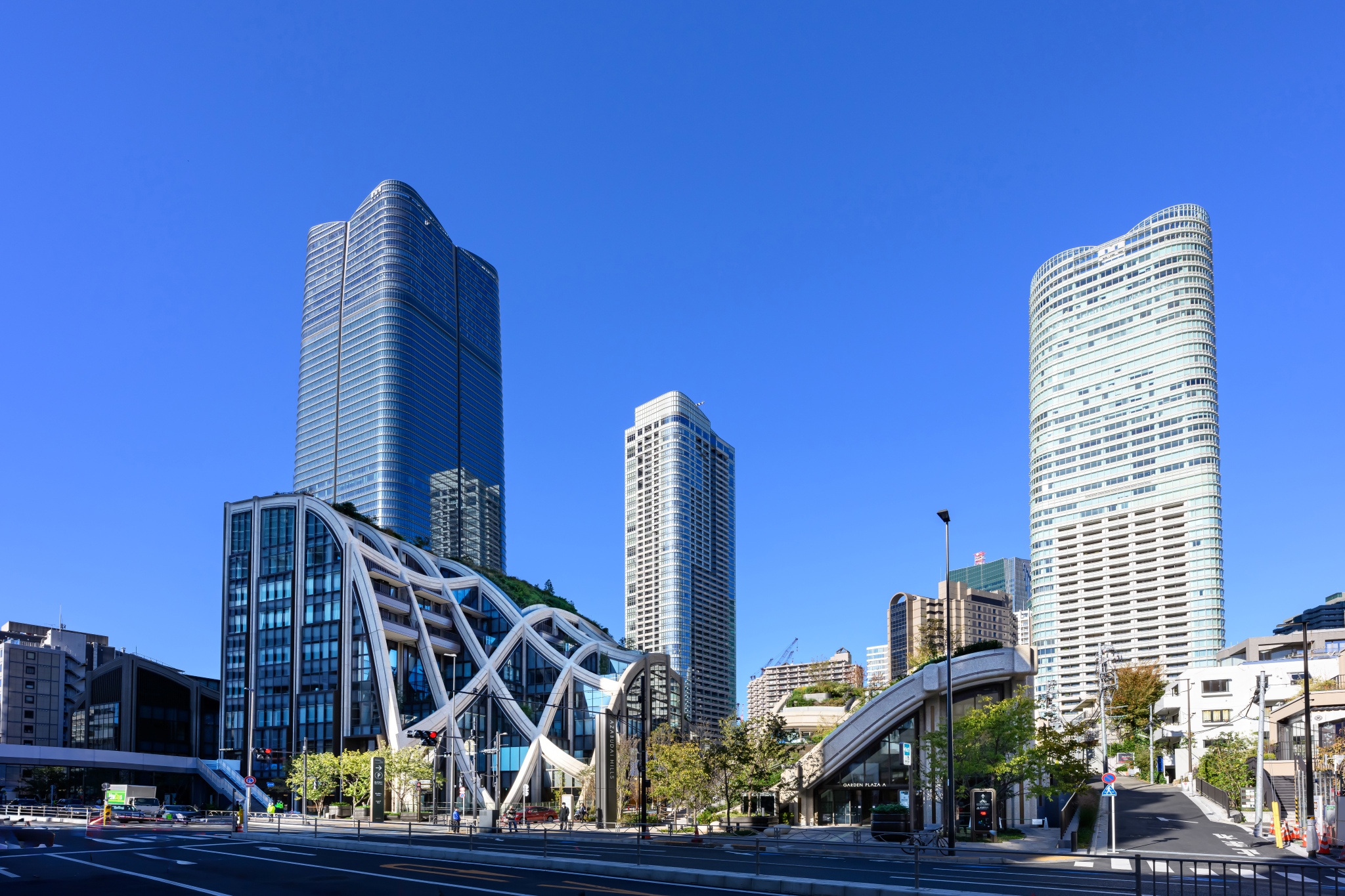
Mori Building’s Azabudai Hills opened in November 2023, the end of a process that began in 1989 when a redevelopment council formed. Over nearly 35 years the company worked with about 300 landowners to consolidate 8.1 hectares in Minato City. By Mori’s account roughly 90% of them agreed, and former residents were offered units in the new buildings.
That long, consensus-based machizukuri, the Japanese practice of community-building, is the foundation under the design that is rarely mentioned. It created a continuous ground plane large enough to plan around nature.
- Mori set the green landscape and central plaza first, then placed the towers around them. The green area runs to 24,000 square meters, including a 6,000 square-meter central plaza.
- Pelli Clarke & Partners designed the three towers; Heatherwick Studio took the public realm, podium and lower landscape, the ground where people move on foot.
- Planting drew on the native profile of the Musashino Plateau, the ecological region that this part of Tokyo grew from. About 320 species went in, including working orchards: eight citrus varieties, apricots, blueberries and a vegetable garden.
The Mori JP Tower on the same ground rises to 330 meters, the tallest building in Japan. Sharing its base with a citrus orchard is one of the odder juxtapositions in recent city-building. The tower fits into the scheme rather than dictating it.
TENGAH, SINGAPORE: ENGINEERING BIOPHILIC CORRIDORS FOR 42,000 HOMES
Tengah has the scale of a whole town:
- 700 hectares in western Singapore, planned for 42,000 homes, 30,000 public and 12,000 private, over about 20 years, on land that returned to secondary forest after its brickworks and military past.
- A forest corridor, 100 meters wide and five kilometers long, run between the Western Catchment Area and the Central Catchment Nature Reserve, with a forest fringe wrapping the town’s edge.
Under HDB’s Biophilic Town Framework, the team worked with the National Parks Board and the Land Transport Authority.
- The team modelled wind flow and solar radiation across the full site before committing infrastructure, then sized and routed the corridor to address the hot spots the model found, using canopy and biomass as the cooling tool.
- Town-center traffic runs underground, which frees the surface for a continuous walking and cycling green and gives Singapore its first car-free HDB town center.
- Vegetated swales and rain gardens collect and clean rainwater and draw birds, butterflies and dragonflies, with mosquito numbers held down through natural predation.
Conservationists at the Nature Society (Singapore) argued in public consultation that 100 meters, pressed between an expressway on one flank and dense housing on the other, may run narrow for larger or more sensitive species, however well it serves birds and small invertebrates.
The town’s shared cooling system, run by the national grid operator, worked through installation and operational wrinkles of the kind large district systems tend to meet early. Tengah is still the one project in this set built first for animal movement between habitats; the cooling and the amenity follow from that.
THE COST OF THE CRITICAL PATH: FINANCIAL AND REGULATORY DRIVERS
Ambition and absurd amounts of capital met a system already willing to reward it: Tokyo’s floor-area incentives and the Otemachi palace condition; Singapore’s City in a Garden and landscape-replacement rules; Thailand’s biodiversity standard and carbon registry; and Japan’s consensus-based machizukuri.
The soil thread runs underneath most of them.
- Trees dropped into stripped, compacted urban ground faced serious problems: broken fungal networks, root zones fighting utilities, microbiomes nothing like forest soil.
- Otemachi’s 200 self-seeded species came out of soil moved whole, seed bank and fungi alive. The Forestias works the same problem from the other end, preparing the substrate hard before planting.
Routing treated wastewater to forest irrigation works as plumbing at The Forestias: a mature transplanted ecosystem in the tropics needs volumes a municipal hookup would strain to guarantee, so the buildings feed the forest, and the forest cools the buildings. Meanwhile, Tengah’s link between two reserves is the only case here built for wildlife movement. The open debate over whether 100 meters is enough is itself a sign the discipline is maturing in residential planning, where it used to be absent.
Set side by side, the projects look nothing alike: a fenced Miyawaki heart in Bang Na, part of a forest trucked in from Chiba with two meters of its soil, towers bent around a Singapore courtyard, a retail street threaded through hundred-year-old trunks, citrus under Japan’s tallest tower, a green spine through a whole town.
Underneath the variety, each decision was made early, cost more than the conventional route, and could not be undone. Everything after had to work around it.
This article, including any associated reports, appendices, exhibits and verbal commentary, is provided strictly for general informational and discussion purposes. Nothing contained herein constitutes financial, investment or legal advice. No statement should be assumed to be profitable, inevitable, or inherently “priced in.” Any forward-looking statements, including projections, engineering estimates, forecasts, targets, or market scenarios, reflect independent judgment as of the date of publication and are inherently subject to uncertainty and change. While certain data has been obtained from third-party sources believed to be reliable, its absolute accuracy cannot be guaranteed. Views expressed belong solely to Arcadia Consulting Vietnam as of the date of this material and are subject to alteration without notice.
Sources and links
- The Forestias, MQDC official project site: https://mqdc.com/theforestias
- The Forestias, development overview (Asia Real Estate Summit): https://www.asiarealestatesummit.com/a-green-oasis-reshaping-greater-bangkok-for-intergenerational-living-and-sustainability/
- The Forestias, sustainable living and forest overview (The Edge Malaysia): https://theedgemalaysia.com/article/modern-and-sustainable-living-amid-forest
- Otemachi Forest, pre-forest method, 1,300 sq.m Kimitsu proxy, soil and biodiversity (Tokyo Tatemono CSR Report 2020): https://tatemono.com/english/sustainability/pdf/2020csr009_e.pdf
- Otemachi Forest, design and Imperial Palace forest lineage (Michel Desvigne Paysagiste): https://micheldesvignepaysagiste.com/en/tokyo-otemachi-0
- Otemachi Forest, soil moved to two metres, 70% deciduous mix (Aman Tokyo): https://www.aman.com/hotels/aman-tokyo/experiences/otemachi-forest
- Tokyo Tatemono, TNFD endorsement and biodiversity disclosure (2025): https://tatemono.com/english/news/20250624.html
- Marina One, Green Heart 37,000 sq.m, 125% site area, 700 trees, 350 species, rice-paddy reference (Archello): https://archello.com/project/marina-one
- Marina One, City in a Garden context and Green Heart (Gustafson Porter + Bowman): https://www.gp-b.com/marina-one
- Sindhorn Village, heritage trees retained, retail layout around trunks (ArchDaily / Architects 49): https://www.archdaily.com/962866/velaa-architects-49
- Sindhorn Village, century-old trees, all trees saved (art4d): https://art4d.com/en/2022/08/sindhorn-village-the-neighbourhood
- Azabudai Hills, official development page, 8.1 ha, 24,000 sq.m greenery, Mori JP Tower 330m (Mori Building): https://www.mori.co.jp/en/projects/azabudaihills/
- Azabudai Hills, 1989 council, ~35 years, ~300 landowners, ~90% agreed, former residents rehoused (The Japan Times, Sustainable Japan): https://sustainable.japantimes.com/unraveling/26
- Azabudai Hills, official launch facts and tallest-building note (Mori Building / Business Wire, 2023): https://www.businesswire.com/news/home/20231123377497/en/Mori-Building-Celebrates-the-Official-Launch-of-Azabudai-Hills
- Azabudai Hills, Heatherwick Studio public realm (Dezeen, 2023): https://www.dezeen.com/2023/11/23/heatherwick-studio-azabudai-hills-district-tokyo/
- Tengah, official Live Green page, 100m x 5km Forest Corridor, Biophilic Town Framework (HDB): https://www.hdb.gov.sg/about-us/history/hdb-towns-your-home/tengah/live-green-at-tengah
- Tengah, Nature Society view that 100m corridor may be insufficient (CNA, 2018): https://www.channelnewsasia.com/singapore/nature-society-urges-hdb-save-more-tengah-new-towns-forests-wildlife-5720641