


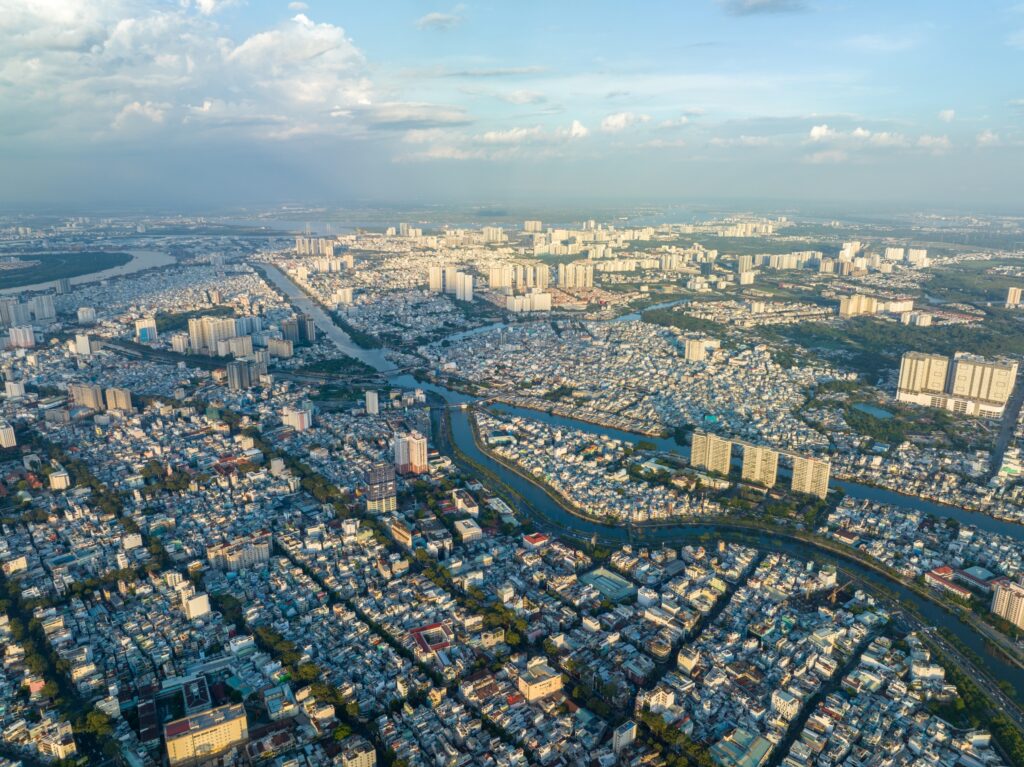
HO CHI MINH CITY’S THE DOORWAY ECONOMY
The Ho Chi Minh City map changed on 1 July 2025. Old District 5 now sits inside Chợ Quán, An Đông and Chợ Lớn. Old District 10 became Diên Hồng, Vườn Lài and Hòa Hưng. Old District 11 became Minh Phụng, Bình Thới, Hòa Bình and Phú Thọ. On paper, the names moved, while on the street, many may still say District 5, District 10 and District 11.
These districts still trade on old mental maps. Chợ Lớn means wholesale, trust, family capital, medicine, cloths, gold, food, temples, alleys that know exactly what they are doing. Sư Vạn Hạnh means student traffic, clinics, lunch money, dorm pressure and small landlords. Lê Đại Hành and the Đầm Sen side carry another register: working households, amusement spending, school runs, small repairs, second shifts.
District 5, District 10 and District 11 hold the heaviest concentration of apex public healthcare in Vietnam’s entire southern region. A tight cluster of 17 tier 1, final-referral hospitals such as Chợ Rẫy, Nguyễn Tri Phương, Hùng Vương, Phạm Ngọc Thạch, Nhân Dân 115, Chấn Thương Chỉnh Hình, Nhi Đồng 1 exerts a massive gravitational pull, acting as the city’s century-old, recession-proof economic engine.
The street capitalizes the whole stack. The old inner belt runs on a high-density retail capitalization model: a single address can hold several revenue streams, several generations and several layers of informal credit. Pick one street and walk it like you have rent at risk.
DENSITY IS THE FIRST INPUT
The ward-level density numbers are almost flabbergasted. Vườn Lài has been reported at 81,950 people per square kilometer, An Đông at 61,537 and Minh Phụng at 58,629. The old Ho Chi Minh City average before the provincial merger was roughly 4,544 people per square kilometer.
A dense street does something a spreadsheet cannot fake by shortening every errand. A child can walk to school. A small trader can move stock by motorbike instead of calling a truck. A hawker can test demand with one cart and three plastic stools.
Land value here begins with saved time. The buildings may be old and the wiring may make a careful person nervous, but the asset still sells an extremely clean product: proximity.
A student renting near Sư Vạn Hạnh is buying a shorter day. A nurse near Nguyễn Trãi is buying less traffic jam. A family inside a 60-square-meter shophouse accepts tight air and bad storage because the school, market, clinic, temple, pharmacy and supplier sit nearby. The arithmetic is enough for that decision.
THE PREMIUM IS TIME
The cheapest rent often sits far from what creates income. Bình Tân, Bình Chánh, Hóc Môn, Củ Chi, Nhà Bè all have their own logic, and many households choose them for good reasons. In District 5, District 10 and District 11, the rent premium comes from removing travel from the day. If a person saves about one hour a day on commuting, that becomes roughly 22 extra working days a year.
For land pricing, that time must be capitalized. A property within a true walking loop of food, school, health care, suppliers and public transport deserves a different yield assumption from a unit that only has road frontage. The frontage is visible while the time bank sits behind it.
A plain alley house can hold value in a way that irritates outside buyers. While the buyer sees poor frontage and old construction, the tenant sees a working day that stays manageable, the landlord sees low churn, and the household sees survival.
THE DOORWAY IS THE ASSET
The doorway economy is simple. One physical asset generates overlapping revenue streams.
Dawn begins with a hủ tiếu cart. By 7am, the main shop opens: thuốc bắc (Northern/ Traditional Chinese Medicine) on Hải Thượng Lãn Ông, fabric near Soái Kình Lâm and the surrounding lanes, spare parts toward Nhật Tảo, food service near Sư Vạn Hạnh, small retail near school gates. Behind that, a relative handles delivery. Upstairs, stock sits beside a bedroom. One room may be rented to a student or a cousin newly arrived from another province. At night, the front room can become a packaging table or a repair desk.
Five streams can sit inside one address:
- The formal lease or owner-operated shop;
- The movable street trade attached to the frontage;
- Storage and wholesale handling behind the shop;
- Family labor and after-hours work inside the unit;
- Room rental, tutoring, delivery, repair, or other side income upstairs.
The actual capitalization base is messy and measurable if someone bothers to measure it.
Local bankers usually know more than outside analysts assume. A branch officer or card team can see fragments of this system through balances, transfers, QR collections, repayment habits and seasonal stress.
A shophouse that looks like a 3% or 4% yield asset under a formal lease model may behave like a stronger instrument because the household earns beyond the lease. The premium comes from occupancy stickiness. During stress, the family cuts spending, shares labor, leans on supplier credit, borrows from relatives and keeps the address alive. Vacancy stays low because leaving means giving up a whole network, far beyond the shopfront.
That valuable stickiness also carries risk. Thin labor protection, fire prevention, or uninsured stock. A family quarrel can damage the business faster than a rate hike. The structure is durable at the district level and fragile inside the household.
TRUST LOWERS TRANSACTION COSTS
Chợ Lớn has old institutions that still do economic work. The hội quán, temples, clan links, festival committees, supplier introductions and family reputations are part of the credit system. They are cultural on the surface and cost saving underneath.
Tuệ Thành, Nghĩa An, Nhị Phủ, Ôn Lăng, Hà Chương and the other old halls around Chợ Lớn should be read as civic infrastructure. They preserve memory, yes, but memory has practical uses. A supplier knows which family pays late but pays. A shop owner can introduce a cousin to a wholesaler without a formal guarantee. A festival donation, a lantern auction, a school fund, a funeral committee, a temple relationship: each one keeps account of people in ways that formal credit scoring rarely reaches.
Public policy increasingly understands Chợ Lớn as living heritage. Hội quán, temples, festivals, old streets, shop signs, medicine streets and family associations give the area protection that a normal retail strip does not have. But heritage policy usually protects the visible layer first: buildings, rituals, routes, facades, memory and tourism value. Land pricing needs the next layer as well. The same cultural network also keeps suppliers close, and keeps shopfronts occupied when a normal tenant would leave.
Old transaction systems have pressure as they can exclude outsiders. They can keep young people under family obligation longer than they want, or hide weak balance sheets behind reputation. Still, when the question is why land stays sticky, trust is a yield input. In these wards, it is embedded in the street.
Hải Thượng Lãn Ông has nearly 100 stores dealing in thuốc bắc and medicinal materials with wholesale and retail flows reaching beyond the city. While medicine business is visible, its information is rather hidden business: which herb is moving before Tết, which clinic orders less this month, which old customer has started buying smaller quantities, and which family still pays on time.
THE STREET REPORTS BEFORE THE SPREADSHEET
Street-level signals arrive early because households adjust before institutions publish. The old inner districts release these signals daily.
Around the universities in District 10, watch meals. Students skip the second drink, or a broken rice portion for lunch shrinks. These are small changes, but they move before wage data, retail reports and office-market commentary.
Near Đầm Sen, the weekend crowd size is less significant than the mix: food court baskets, ride tickets, family groups, repeat visits, how long people stay after sunset. This is a working household thermometer for the western inner ring. A slow weekend after a wet month means little. Two soft months during decent weather deserve attention.
On Hải Thượng Lãn Ông, thuốc bắc stock is a household health-spending signal. Tonic purchases for older parents are often discretionary at the margin. Families usually cut other items first, then adjust quantities. Before Tết, heavier stock can show confidence. Thinner visible inventory can mean tighter cash or weaker expectations. Weather, supply price, import timing and festival calendar can distort it.
Nhật Tảo and the repair lanes add another layer. Secondhand electronics and parts trading are often counter-cyclical in feeling. When people repair rather than replace, those counters get busier. Credit gets extended to regulars.
Some of these signals now leave digital traces. QR payments, bank transfers, e-wallet receipts and tax-linked records are pulling part of the old cash economy into formal view. Useful, and still partial. The street remains ahead because it shows the stock movement, the opened shutter, the extra delivery run and the family member who quietly joined the business this month.
SHOCK ABSORPTION HAS A PRICE
When the city slows, these neighborhoods absorb part of the impact. Fall in small-export margins becomes delayed tuition payment, extra delivery hours, or a new cart outside the doorway. A family that once used one revenue stream begins using three.
The adjustment has been pushed into households. For investors, that buffer is useful when it keeps occupancy stable and gives landlords confidence. It also means part of the yield is being produced by household overwork. Push rent beyond the ability of the household to stack income, and the building loses the very multiplier that justified the premium.
Household resilience can protect occupancy, but it can also hide strain. A full shopfront does not always mean a healthy household. The family may face delayed repairs, more debt to suppliers, or one more relative working without pay. The yield is sticky partly because the family carries the hardship before the asset does.
METRO LINE 2 REPRICES CONVENIENCE
Metro Line 2, Bến Thành – Tham Lương, broke ground on 15 January 2026. Current reporting puts the project at roughly 11.2 to 11.3 kilometers, following the Bến Thành – Cách Mạng Tháng Tám – Trường Chinh corridor, with completion targeted around 2030. The city has also issued plans for TOD areas around the line, with priority locations including Bến Thành, Bảy Hiền, Tân Bình, Phạm Văn Bạch, and depot Tham Lương. This changes the geometry.
District 5, District 10 and District 11 have long priced convenience through local monopoly. If living near Hòa Hưng or Vườn Lài saves ninety minutes a day, rent can absorb part of that saving. Once outer districts connect to the center with more reliable travel times, the old inner-belt time premium narrows.
Metro Line 2 will reprice time. It will help some blocks, hurt others and leave some behind once construction is fully underway. If a younger renter can live farther out and still reach school or work within a tolerable window, the old District 10 premium must justify itself with more than habit.
Rents inside the 500-800 meter station catchment will be repriced first. It depends on the exact walk and the strength of the existing cluster. A unit technically close to a station but unpleasant to walk from may lag behind a less obvious block with better pedestrian flow.
Construction years will also separate operators. The strongest doorway businesses can absorb dust, blocked access, noise and changes in foot traffic. The surviving addresses may command better rents after the line opens, but that upside belongs to owners who can get through the friction.
THE THINNING PART IS INSIDE THE UNIT
Ho Chi Minh City’s fertility rate has been reported around 1.39 to 1.43 children per woman in recent 2024 figures, far below replacement. The exact figure shifts depending on city boundary and reporting date. Fewer children means fewer future shop successors, fewer siblings to rotate labor and fewer helping hands behind the counter.
The old shophouse model depends on people inside the unit. A three-generation family can make a rough building productive. A two-person household may see the same building as too large, too hard to insure and too expensive to maintain.
By 2035, some buildings will still run the old model. Others may be repurposed to storage, clinics, small logistics, co-living, single-family use, food chains or quiet holding assets. The change will come unevenly. Chợ Lớn has absorbed much larger shocks than a metro line: colonial planning, war, postwar reset, economic reforms and four commercial decades. Still, household size cuts into the engine from inside.
Trade succession runs beside this. Some thuốc bắc families have children trained in modern pharmacy. Some return, and some prefer hospitals, clinics or work abroad. A family business can survive this if the next generation keeps procurement knowledge, customer trust and property control. If the children keep only the property, the land may remain valuable, but the trade cluster weakens.
Each doorway movement tells you something about rent, trust, labor, risk and time.
This article (including any report, appendices, exhibits and verbal commentary) is provided for general informational and discussion purposes only. Nothing herein should be assumed to be profitable, inevitable, or “priced in.” Any forward looking statements, including projections, estimates, forecasts, targets, prospects, scenarios and opinions, reflect judgment as of the date hereof and are inherently uncertain. Certain information has been obtained from third party sources believed to be reliable. Views expressed are those of Arcadia Consulting Vietnam as of the date of this material and may differ from the views of other parties.
Sources and links
- Nghị quyết 1685/NQ-UBTVQH15 – official ward reorganization for Ho Chi Minh City, including Chợ Quán, An Đông, Chợ Lớn, Diên Hồng, Vườn Lài, Hòa Hưng, Minh Phụng, Bình Thới, Hòa Bình and Phú Thọ. https://xaydungchinhsach.chinhphu.vn/toan-van-nghi-quyet-so-1685-nq-ubtvqh15-sap-xep-cac-dvhc-cap-xa-cua-thanh-pho-ho-chi-minh-nam-2025-119250616211341304.htm
- Thanh Niên – Top 10 wards by population density after the HCMC ward merger; includes Vườn Lài, An Đông and Minh Phụng. https://thanhnien.vn/top-10-phuong-co-mat-do-dan-so-cao-nhat-tphcm-sau-sap-nhap-185250715232734862.htm
- Tuổi Trẻ – HCMC average density around 4,544 people per km2 before the provincial-scale merger. https://tuoitre.vn/mat-do-dan-so-tai-tp-hcm-gap-1-7-lan-so-voi-ha-noi-20250222214719029.htm
- VietnamNet – Vietnam national density around 305 people per km2 and HCMC population/density context. https://vietnamnet.vn/thanh-pho-co-dan-so-dong-dan-nhat-ca-nuoc-gap-gan-30-lan-noi-it-dan-nhat-2361141.html
- Thanh Niên – Hải Thượng Lãn Ông as a major traditional medicine street with nearly 100 shops and wholesale/retail flows. https://thanhnien.vn/pho-doc-la-o-tphcm-thu-phu-thuoc-bac-lon-nhat-khu-cho-lon-185241117171701845.htm
- VietnamNet / Dân tộc và Phát triển – architecture and concentration of Chinese community assembly halls in Chợ Lớn. https://dantocphattrien.vietnamnet.vn/kien-truc-hoi-quan-nguoi-hoa-o-cho-lon-1630311855518.htm
- Báo Tin Tức / Dân tộc và Miền núi – cultural life of the Chinese community in Chợ Lớn, including national intangible heritage references. https://dantocmiennui.baotintuc.vn/net-van-hoa-dac-trung-cua-cong-dong-nguoi-hoa-tai-cho-lon-post361153.html
- VnEconomy – Metro Line 2 groundbreaking on 15 January 2026. https://vneconomy.vn/tp-ho-chi-minh-khoi-cong-metro-so-2-va-3-du-an-ha-tang-trong-diem.htm
- Tuổi Trẻ – HCMC TOD planning along Metro Line 2; priority areas include Bến Thành, Bảy Hiền, Tân Bình, Phạm Văn Bạch, and depot Tham Lương. https://tuoitre.vn/tp-hcm-ban-hanh-ke-hoach-thuc-hien-cac-khu-vuc-tod-tai-12-nha-ga-metro-so-2-2025120917551572.htm
- Dân Trí – HCMC 2024 fertility rate reported at 1.39 children per woman, below the national average and replacement level. https://dantri.com.vn/suc-khoe/moi-phu-nu-co-139-con-tphcm-tim-giai-phap-tang-muc-sinh-20250527090003606.htm
- Tuổi Trẻ – HCMC post-merger fertility context, including reported 1.43 figure and lowest nationwide status. https://tuoitre.vn/sieu-do-thi-tp-hcm-hon-14-trieu-dan-co-muc-sinh-thap-nhat-viet-nam-20250925105817865.htm
- AP News – English-language context on Vietnam ending its two-child policy and national fertility decline. https://apnews.com/article/bdcf2b08404d5fcada05d4f3ccc6fa5e