


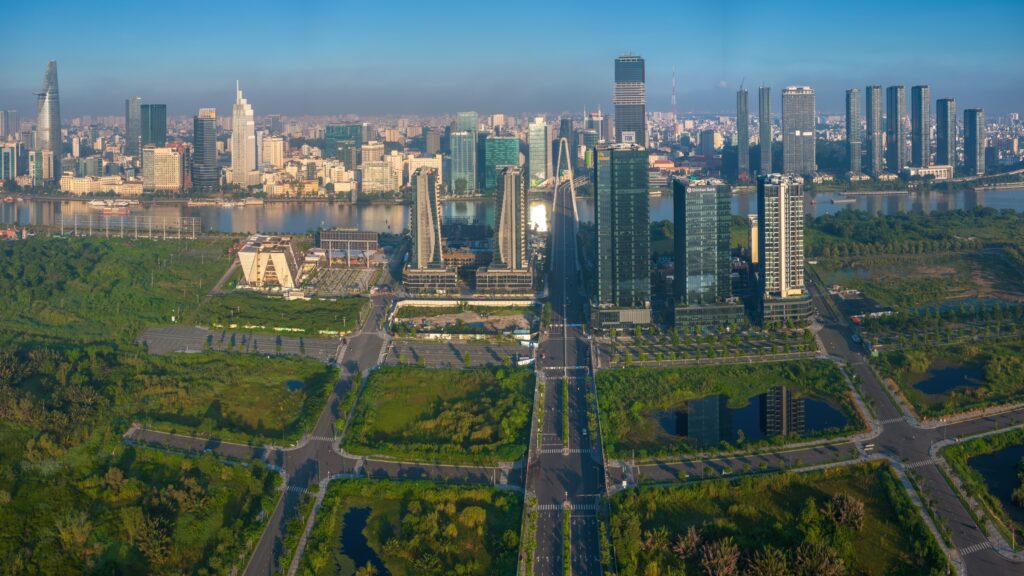
VIETNAM’S REAL ESTATE MARKET: EYEING LOAN-TO-VALUE CAPS FOR SECOND HOMES
Vietnam’s Ministry of Construction is proposing strict loan-to-value caps, including 50% for second homes and 30% for third and subsequent purchases to deter speculation and restrain prices. The measures appear in a draft resolution on real estate price control sent to ministries for comment. The package works on three fronts: tighter mortgages for multi-home buyers, regulated real estate trading centers, and more commercially built, reasonably priced housing.
Today, banks commonly lend 70%–80% of collateral value. Developers often take 10%–30% down, enabling 70%–90% leverage sweetened by interest-free and principal-grace promos that investors have used to hoard and flip units. Credit exposure is swelling. Housing-related loans totaled roughly VND 4 quadrillion as of end August, up 19% from a year earlier, State Bank of Vietnam data show.
Why the clampdown: housing and banking are tightly linked, and prices have outrun incomes. In Hanoi, apartments average VND 70–80 million per sqm, up 5.6% year-to-date; townhouses and villas fetch VND 100–200 million. In Ho Chi Minh City, apartment prices jumped from ~VND 35 million to more than VND 91 million per sqm between 2018 and 2024, about a 160% gain while per-capita income rose only 6%–7% annually, eroding affordability.
Vietnam’s 2023 Housing Law opens the door to foreign buyers, including allowing purchases, lease-purchases, gifts and inheritance while imposing tight quotas and time limits: holdings are capped at 30% of units in any condominium and up to 250 individual houses in ward-equivalent area; tenure is leasehold only, limited to 50 years with possible renewal, and confers no perpetual land-use rights.
Policymakers say Vietnam’s market tools such as tax, credit, planning, state land pricing remain patchy, allowing speculation and hype to overshadow real supply–demand. The ministry calls targeted price-restraint measures “necessary” to stabilize a market that’s increasingly out of reach for younger households and urban workers.
A CAUTIOUS SCAN OF WHAT PEER MARKETS HAVE DONE TO REIN IN DEMAND FOR SECOND AND FURTHER HOMES
Singapore: Heavy stamp duties and multi-layered hard credit caps is a well-tested combination that dampens leveraged investor demand while preserving first-home access.
- ABSD: Since 27 Apr 2023, a Singapore citizen’s 2nd home = 20% ABSD; 3rd+ = 30%. PRs: 2nd = 30%, 3rd+ = 35%. Foreigners: 60%. Entities 65% (developers: 35% + non-remittable 5%).
- Credit caps: TDSR capped at 55% of gross monthly income (tightened from 60% in Dec 2021). Tiered LTVs from banks fall as you hold more mortgages (commonly 45% on a 2nd loan; 35% on a 3rd+ if tenure ≤30 years, lower if longer). HDB loan LTV aligned to 75% (Aug 2024).
Thailand: Temporary LTV relaxation instead of tightening to support a weak market.
- The Bank of Thailand (BOT) tightened LTVs effective 1 Apr 2019, introducing higher down-payments for additional mortgages. By Jan 2020, BOT fine-tuned the rule: for second homes < THB 10m, 10% down if the first mortgage has been serviced ≥2 years, otherwise 20%; third+ homes generally 30% down (≈ 70% LTV). This directly targets leveraged repeat buyers.
- To aid a slumping property sector, BOT temporarily lifted LTVs up to 100% for loan contracts signed from 1 May 2025 to 30 Jun 2026, including second homes under THB 10m, and first homes above THB 10m.
- Anti-flip transaction tax (Specific Business Tax, SBT): 3.3% is generally payable when an individual sells within 5 years of acquisition (with listed exemptions), discouraging quick resales that often accompany speculative 2nd/3rd purchases.
South Korea: Targeted, very tight local LTV for multi-homeowners to rapidly cool transactions in hot spots, and require careful calibration to avoid spillovers.
- In 2025, authorities suspended/near-zeroed LTV for additional-home purchases in designated speculative zones of Seoul; subsequently tightened LTV to 40% in affluent districts.
Taiwan (China): Selective credit controls to reduce speculative borrowing, especially in the big eight cities.
- Since 2020, multiple rounds: lower LTVs for 2nd loans (e.g., 60% in major cities; 50% nationwide from Sept 2024 for borrowers with one outstanding housing loan), and 30% LTV caps for 3rd+ loans/high-value homes, no grace periods, tighter rules in major metros.
United Kingdom (England & North Ireland): Higher SDLT on additional dwellings is simply administer and raises revenue; has limited impact on all-cash buyers.
- From 31 Oct 2024, the surcharge on 2nd homes rose from 3% → 5%, applied on top of the standard SDLT bands (now 5%, 7%, 10%, 15%, 17%).
- Scotland (separate system): Additional Dwelling Supplement = 8% from 5 Dec 2024 (up from 6%).
Canada: Foreign-buyer ban and vacancy/underuse taxes
- Foreign-buyer ban extended to Jan 1, 2027.
- Federal Underused Housing Tax: 1% annual levy on vacant/underused housing (primarily non-residents).
- Municipal vacancy taxes: e.g., Vancouver Empty Homes Tax = 3% (kept at 3% after a proposed 5%).